


The corporate world of Silicon Valley is currently undergoing a major transformation, driven by automated software infrastructure and AI technology. One of the biggest restructuring moves of 2026 has officially begun, known as Intuit Layoffs 2026. Financial software giant Intuit Inc. (INTU) has decided to reduce approximately 17% of its global workforce. This major decision will impact approximately 3,000 employees, causing a stir not only in the technology sector but throughout Wall Street.
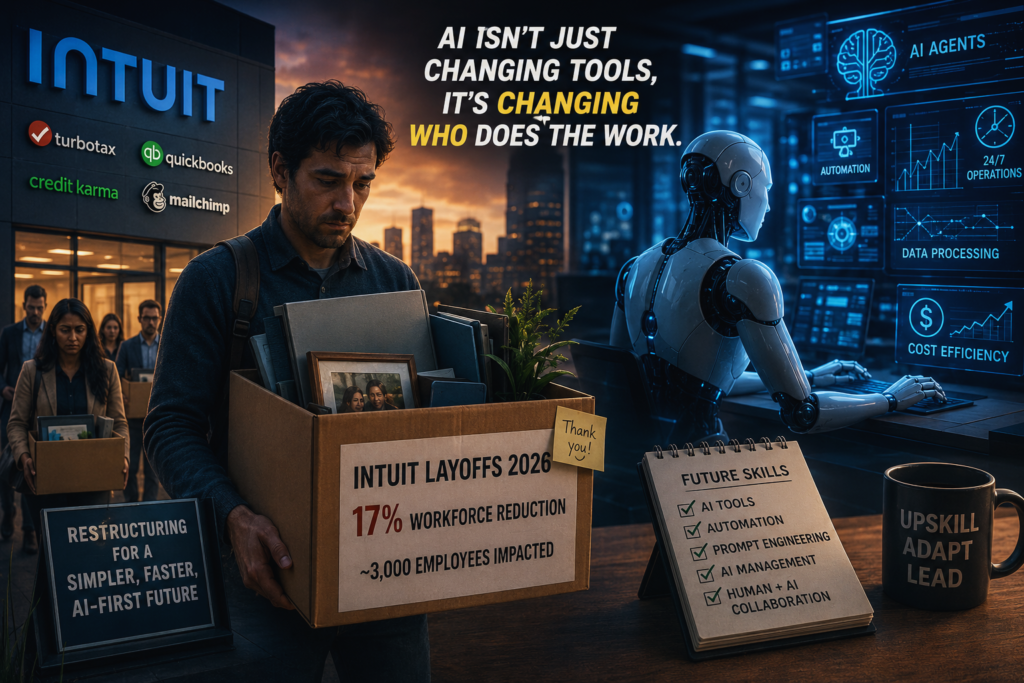
This sudden corporate downsizing by Intuit, the maker of popular financial platforms like TurboTax, QuickBooks, Credit Karma, and Mailchimp, is being considered a major turning point for Silicon Valley. It directly addresses the question the entire corporate world is asking today—is generative AI making companies more efficient, or is it about to become the biggest jobs crisis of the future?
What’s behind Intuit Layoffs 2026?
According to an internal memo released by the company’s CEO, Sasan Goodarzi, this massive workforce reduction is being done to reduce the company’s organizational complexity and accelerate software product development.
This corporate restructuring will cost the company approximately $300 million to $340 million, including employee severance packages and transition costs.
Although Intuit executives stated during the third-quarter earnings call that the main purpose of the downsizing was to “simplify” the company structure, the company also made it clear that its primary focus will now be on AI product integration.
Intuit Layoffs 2026 shows that the company is aggressively “rightsizing” its workforce to invest more in AI-powered financial, tax, accounting, and automated customer marketing tools.
The money saved on human salaries will now be invested directly in multi-year licensing deals with AI companies like OpenAI and Anthropic.
The Tech Sector Is Rapidly Becoming AI-First
The Intuit Layoffs 2026 aren’t an isolated incident. According to recent global tech workforce reports, major companies like Meta, Amazon, LinkedIn, Cisco, and Microsoft have eliminated over 110,000 jobs combined.
What’s most shocking is that these layoffs aren’t due to financial losses. Many of these companies are still reporting strong revenue, solid quarterly earnings, and high profit margins.
In fact, companies are reducing human labor spending and investing billions of dollars in AI infrastructure, machine learning models, and autonomous AI agents.
Now, businesses are looking to create an “AI-first” operational framework, where a smarter digital ecosystem functions smoothly with fewer human engineering teams.
Human Workforce vs. AI Framework
The reason why automation is winning in today’s modern software business model is quite clear.
Financial Structure
Earlier, companies’ largest operational expenses were salaries, health benefits, and office infrastructure. AI systems run on usage-based API token models, which are proving to be much cheaper and more predictable in the long term.
Operational Scaling
Scaling a traditional human workforce requires hiring, onboarding, and months of training. Enterprise AI systems can instantly scale across multiple servers and handle heavy traffic.
Productivity Output
Humans’ greatest strengths are contextual understanding and critical thinking. AI’s greatest strengths are 24/7 nonstop operations and massive automated data processing capabilities.
What impact did it have on Wall Street and INTU stock?
The stock market witnessed significant volatility immediately following the official announcement. As soon as news of the 17% workforce reduction broke, Intuit shares fell nearly 11% in extended trading.
Investors appeared cautious about short-term restructuring costs and near-term slowing growth concerns.
However, long-term market analysts remain optimistic about the AI restructuring strategy. Wall Street often rewards tech companies that reduce operational human overhead by focusing on automation and high-margin systems.
By investing in embedded generative AI capabilities, Intuit aims to achieve sustainable long-term profitable growth in the future, allowing company margins to reach record highs.
The Future of Work Has Completely Changed
Intuit Layoffs 2026 has made one thing clear—traditional tech and finance jobs are rapidly changing.
The job market is no longer limited to coding or basic data management. The real value now lies in those who know how to manage AI.
For professionals who want to secure their career growth in the future, upskilling is no longer optional.
In this new AI-driven world, only those who learn to work with AI tools and become the human architects behind autonomous workflows will survive.
https://unitedupdatess.com/wp-admin/post.php?post=2979&action=edit