


A few years back, I was talking to an old coworker who was getting ready to retire. I asked him what his biggest financial regret was, expecting him to mention a bad investment or an expensive purchase. Instead, he paused for a second, smiled, and said, “I wish someone had sat me down at twenty-two and explained compound interest.”
That answer stuck with me. I understood the basic idea back then, but hearing someone in his sixties genuinely wish he had started earlier made it feel much more real. It wasn’t about making a fortune overnight. It was about realizing that time is something you can’t earn back.
Most of us grow up believing that saving money simply means putting whatever is left into a bank account. There’s nothing wrong with saving, but if that’s all you do, your money isn’t working very hard. Investing changes the picture because your money doesn’t just sit there anymore. It starts working alongside you.
That’s where compound interest changes everything.
What Is Compound Interest?
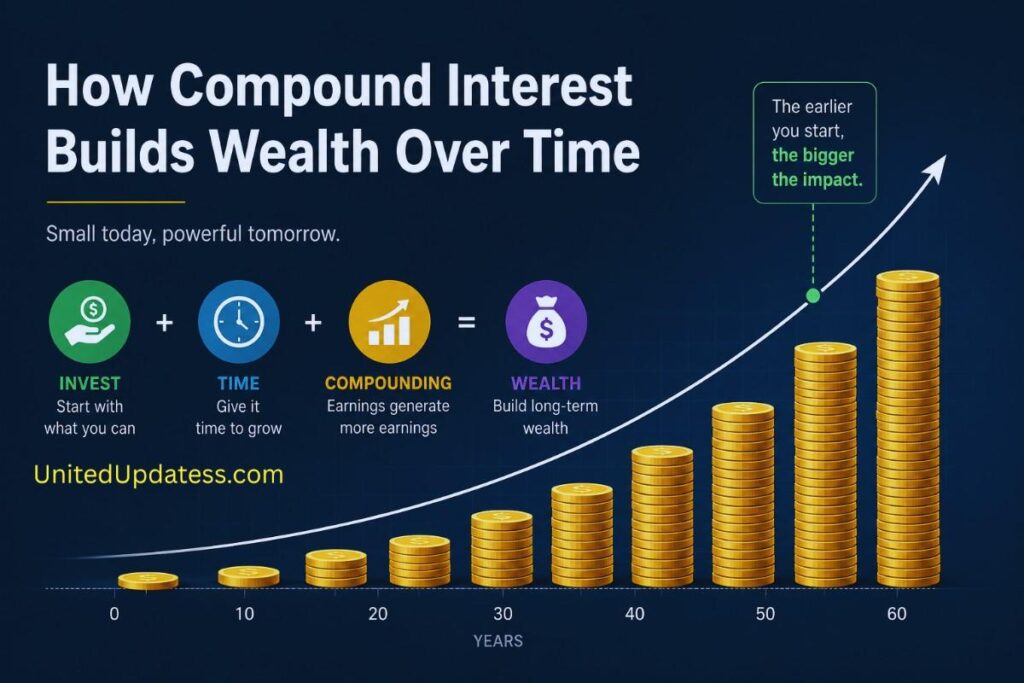
In simple terms, your money earns returns, and after a while those returns start earning money too. That’s really all compound interest is. Instead of growing in a straight line, your money slowly begins building on itself.
Imagine rolling a small snowball down a long snowy hill. At first, it barely changes. Then it starts picking up more snow. As it gets bigger, every turn adds even more. By the time it reaches the bottom, it’s far larger than when it started—not because you pushed harder, but because you gave it enough distance to keep rolling.
Money behaves in much the same way. Your first investment is the snowball, while time gives it room to keep growing. The longer it rolls, the bigger it becomes.
Why Starting Early Matters More Than Investing More
One mistake a lot of people make is waiting until they earn a higher salary before they start investing.
It’s easy to think, “I’ll start once I’m making more money.”
The problem is that time is often more valuable than the amount you invest when taking advantage of compound interest
Take two friends, Maya and Chris.
Maya starts investing at 22 and puts away $200 each month for ten years. At 32, she stops contributing altogether after investing a total of $24,000.
Chris waits until he’s 32 before he starts. He also invests $200 every month but continues all the way until he turns 62, contributing a total of $72,000.
Even though Chris invested three times as much money, Maya could still finish with a larger retirement balance if both investments earned similar long-term market returns. The extra decade her money had to grow made an incredible difference.
The first time I saw an example like this, it honestly felt unfair. How could someone invest less money and still end up ahead? But that’s exactly what makes compounding so powerful. Time quietly does most of the heavy lifting.
How to Put Compounding to Work
You don’t need a finance degree or thousands of dollars to make compound interest work for you. The hardest part is usually getting started.
Start with What You Can Afford
Don’t wait until you have a huge amount to invest. Even $25 or $50 a month can get the process moving. The amount matters less than building the habit and sticking with it.
Make It Automatic
Setting up an automatic transfer every payday removes the temptation to spend the money first. Once the process runs on its own, staying consistent becomes much easier.
Reinvest Your Earnings
If your investments pay dividends or other earnings, resist the urge to cash them out. Reinvesting those returns gives your money another chance to keep growing.
Compounding Can Also Work Against You
There’s another side to this that doesn’t get enough attention.
The same math that helps investments grow can also make debt much more expensive.
Credit card balances are a perfect example. Interest gets added to what you already owe, and future interest is calculated on that larger balance. What starts as a manageable amount can grow surprisingly fast if you only make minimum payments.
That’s why paying off high-interest debt is often one of the smartest financial decisions you can make before focusing heavily on investing.
The Biggest Advantage Is Patience
Building wealth usually isn’t exciting.
For the first few years, your progress may feel so slow that you wonder whether it’s making any difference at all. That’s completely normal.
Compound growth often feels invisible in the beginning. Then one day you look back and realize the numbers are finally moving faster than they used to. What seemed small and insignificant starts building real momentum.
In the end, compound interest isn’t about getting rich quickly. It’s about giving your money enough time to do what it does best. Start whenever you can, even if it’s a small amount, and let consistency handle the rest.