


Let’s be honest for a second.
Finding simple budgeting methods that actually work is hard because most advice online sounds like it was written for a robot. Let’s be completely honest for a second: most tips sound amazing on paper until you actually sit down to follow them.
People will tell you to track every expense, maintain detailed spreadsheets, categorize every purchase, and review your spending habits every single day. It all sounds reasonable in theory. In reality, most people are busy, get distracted, or simply lose interest after a week or two.
I’ve tried some of those methods myself. For a few days, everything feels organized and under control. Then life gets busy, motivation disappears, and suddenly you’re wondering where all your money went.
The truth is that budgeting shouldn’t feel like a second job.
A good budget isn’t the most detailed one. It’s the one you’ll still be following three months from now.
If you are tired of tracking every single rupee, switching to simple budgeting methods can actually give you control without melting your brain
Here are a few budgeting methods that real people actually stick with.
The 50/30/20 Rule: Simple and Stress-Free
If numbers make your eyes glaze over, this method is a great place to start.
The idea is incredibly simple.
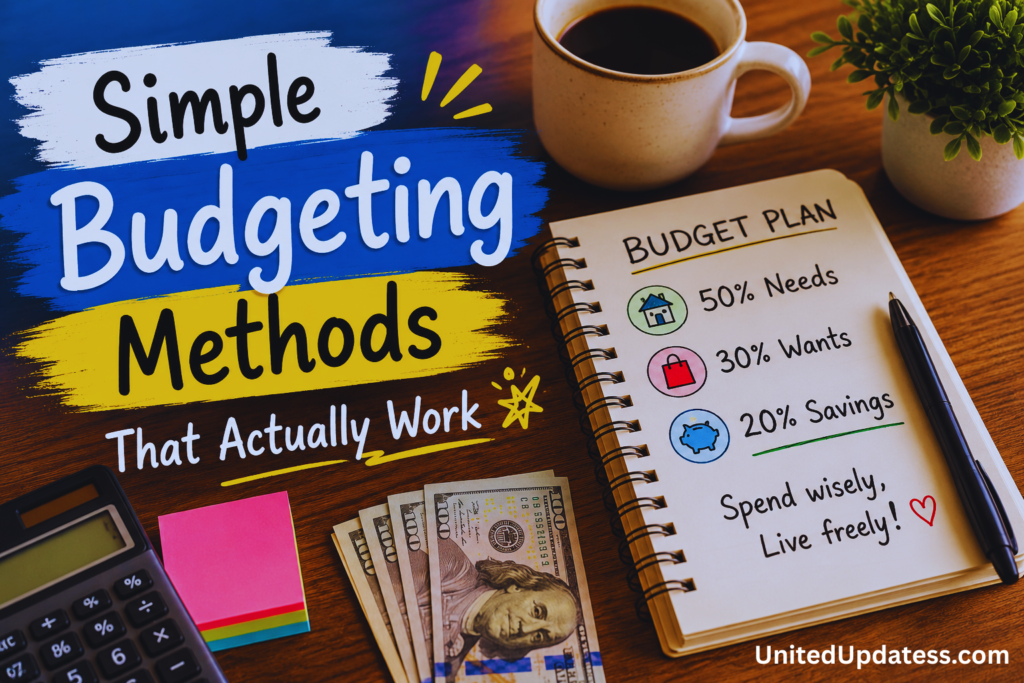
You divide your monthly income into three categories:
- 50% for essential expenses
- 30% for personal spending
- 20% for savings and investments
That’s it.
The first category covers things like housing, groceries, utilities, insurance, and transportation. These are the expenses you can’t really avoid.
The second category is for enjoying life. Going out with friends, ordering your favorite food, watching movies, buying something you’ve wanted for a while—those things belong here.
The final category is dedicated to your future. Savings, investments, emergency funds, or paying down debt.
What makes this approach work so well compared to other simple budgeting methods is the balance.
For many people, that’s enough structure without feeling restrictive.
The Envelope System: A Surprisingly Effective Old-School Method
Technology has made spending money incredibly convenient.
Sometimes a little too convenient.
A quick tap on your phone and the purchase is complete. Because money moves digitally, it often doesn’t feel like real spending.
That’s why the envelope system still works surprisingly well.
At the beginning of the month, decide how much money you’ll spend in certain categories such as groceries, entertainment, dining out, or fuel. Withdraw that amount in cash and place it into separate envelopes.
When the envelope is empty, spending in that category stops until next month.
Simple.
A lot of people are surprised by how much this changes their behavior. Handing over physical cash creates a different feeling than pressing a button on a screen.
You become more aware of where your money is going.
And awareness alone can solve a lot of spending problems.
People call this one of the most effective simple budgeting methods out there, officially known as the Envelope System
Reverse Budgeting: Save First and Forget About It
One of the biggest mistakes people make is waiting until the end of the month to save money.
The problem is that life usually finds a way to spend whatever is left.
That’s why reverse budgeting is a total game-changer among simple budgeting methods, especially for lazy people
The moment your paycheck arrives, automatically transfer a percentage into savings or investments.
Some people choose 10%. Others prefer 15% or even 20%.
The exact number matters less than the habit itself.
Once the money is moved, treat it as if it never existed.
Then live on the remaining amount.
One friend of mine started doing this years ago. He didn’t create a detailed budget or track every purchase. He simply automated his savings and forgot about it.
A year later, he had accumulated more savings than he had managed in the previous several years combined.
Sometimes the simplest systems are the most effective.
Values-Based Budgeting: Spend More on What Matters
Not all spending is equal.
Some purchases genuinely improve your life. Others barely make you happy for more than a few hours.
Another choice among simple budgeting methods is called Values-Based Budgeting.
Instead of obsessing over every dollar, take a look at your recent spending and ask yourself a simple question:
“Which purchases actually made my life better?”
You may discover that certain expenses bring real enjoyment, while others are little more than habits.
For example, maybe you love traveling, but you’re paying for three streaming services you rarely use.
Or perhaps you enjoy fitness but keep spending money on things that don’t add much value to your daily life.
The goal isn’t to spend less.
The goal is to spend more intentionally.
When your spending reflects your priorities, budgeting feels less like a restriction and more like a choice.
Zero-Based Budgeting: Give Every Dollar a Purpose
If you like having a clear plan, this method may be worth trying.
With zero-based budgeting, every dollar of income is assigned a specific job before the month begins.
Nothing remains unplanned.
Let’s say your monthly income is $3,000.
You might allocate:
- $1,200 for housing
- $500 for groceries
- $600 for savings
- $300 for transportation
- $400 for personal spending
The goal isn’t to spend every dollar.
The goal is to decide where every dollar should go before it disappears on its own.
Many people find that this method helps them feel more in control because they know exactly where their money is supposed to go.
There’s less guessing and fewer surprises.
Why Simple Budgeting Methods Save Your Sanity
The best budgeting method isn’t the one financial experts argue about online.
- Pick one of these simple budgeting methods and try it for a month.
Some people love detailed planning. Others prefer something simple and automatic. Neither approach is right or wrong.
What matters is finding a system that fits your personality and lifestyle.
If you’ve struggled with budgeting before, don’t assume you’re bad with money.
Sometimes the method simply wasn’t a good match.
Pick one of these approaches and try it for a month. Make small adjustments as you go. You don’t need a perfect system from day one.
Managing money is a skill, and like any skill, it gets easier with practice.
The goal isn’t perfection.
The goal is making your money work a little better for you each month.